Spoiler Note:
This article contains detailed discussions of character arcs from The Hobbit, George MacDonald’s Sir Gibbie and The Shepherd’s Castle, and the Dune prequel novels by Brian Herbert and Kevin J. Anderson. Key plot points—including endings—are explored in depth.
“A chef is not necessarily the best judge of food.”
— C. S. Lewis, A Preface to Paradise Lost
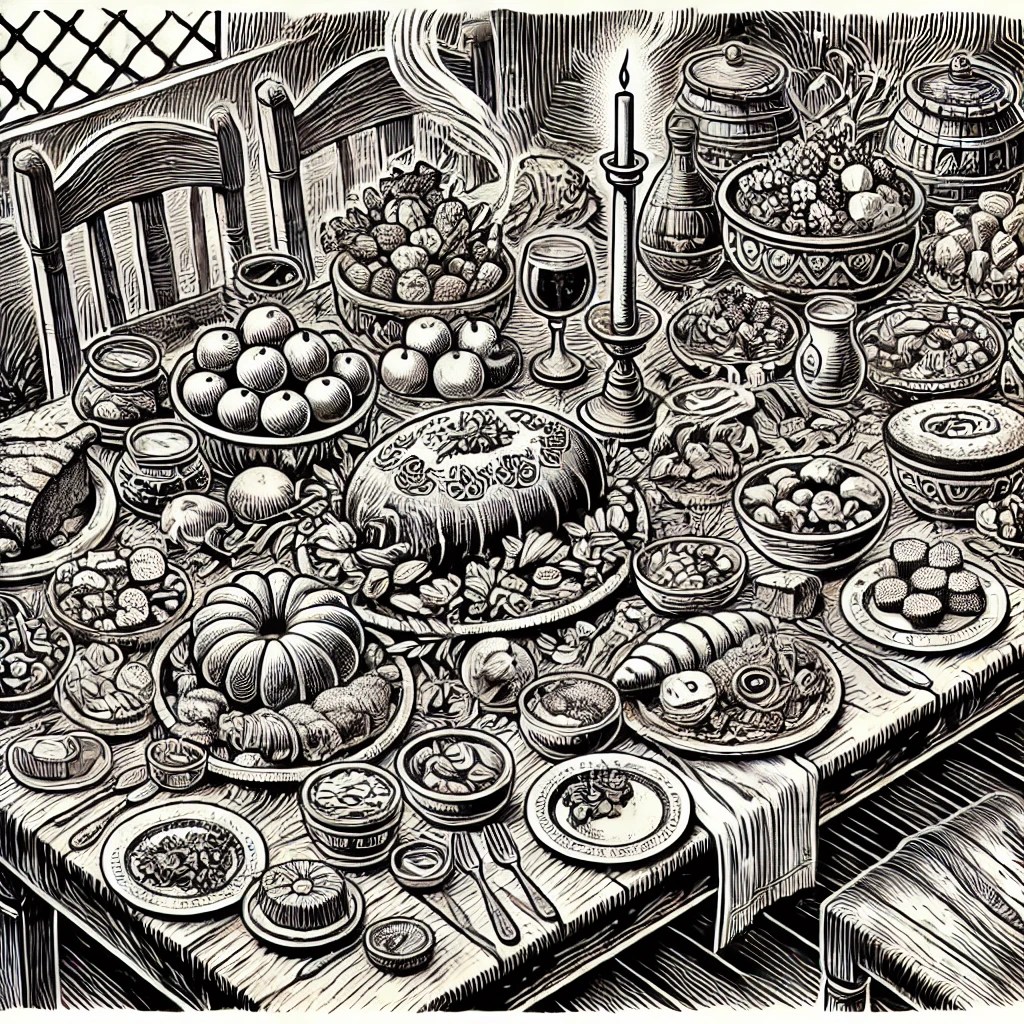
C. S. Lewis once pushed back against the idea that only poets can judge poetry. He compared literary judgment to food: knowing how something is made doesn’t guarantee you know whether it’s good. That image has stuck with me—not because I’m trying to settle the critic vs. creator debate, but because it raises a deeper question, especially for writers:
What makes a story—particularly a character arc—taste true?
We know there are characters that live in us long after the last page. But what makes them so? It’s not genre, or fame, or even beautiful prose. It’s something deeper—something like humanity, transformation, or truth-telling. And to recognize that, or better yet, to write it, we need something more than technique. We need taste. Generous, cultivated, well-traveled taste.
Too often, we meet people who believe that all good food tastes like their own cooking. But real discernment requires more than personal preference. It requires humility, experience, and a willingness to be surprised.
That’s why I admire someone like Gordon Ramsay. Whatever else you think of him, he’s not a snob. He’s been equally revolted by lifeless five-star dishes and moved to genuine delight by guinea pig roasted in a stone hut high in the Andes. His judgment is respected not because he’s a celebrity chef, but because he has tasted broadly—and learned to recognize what is good wherever it appears.
Literary taste works the same way. If we want to understand what makes a character arc resonate—what makes a transformation feel true—we must read beyond our own genre, time period, and cultural preferences. A great character doesn’t have to look or speak like us. They have to live.
Consider three wildly different characters: Bilbo Baggins, Norma Cenva, and Donal Grant.
Bilbo Baggins, the unlikely hero of The Hobbit, begins his story tightly bound by the expectations of his neighbors—and of himself. In the quiet, well-kept lanes of Hobbiton, being “respectable” means never doing anything adventurous, unexpected, or uncomfortable. And Bilbo clings to this ideal, convinced it’s who he truly is. But even in those early chapters, we glimpse something more. He lingers over tales of Elves and long-forgotten treasures. There’s a part of him—deeper and older—that yearns for beauty and wonder. He is not as dull as he pretends.
He joins Thorin and Company not out of bravery, but out of fear—fear of being thought a coward. His early attempts to prove himself nearly get everyone killed, as in the bungled encounter with the trolls. But something begins to shift as the journey wears on. Bilbo’s longing for his pipe and tea becomes a kind of crucible, burning away the comforts that once defined him. No longer acting to impress, he begins acting from conviction—from a growing awareness of what is right, and what must be done.
This change is clearest in his encounters with Gollum, the spiders of Mirkwood, and the Elvenking’s prison. In each case, Bilbo acts not out of pride but out of necessity and inner strength. By the time he makes his most courageous decision—secretly giving away the Arkenstone to prevent a war—he stands utterly alone. The dwarves are furious. No one praises him but Gandalf. And yet, in that solitary act of peace-making, we see how far he’s come: not a warrior, not a king, but a quiet hero who saves lives because it is right to do so.
Bilbo never becomes a grand figure. He never seeks glory. At the Battle of the Five Armies, he does little that would impress the songs of men or dwarves. But he is present, faithful, and true. His weeping at Thorin’s death, and Thorin’s final recognition of his wisdom, seals the journey. And when Bilbo returns home—stripped of reputation, presumed dead, his belongings sold off—he doesn’t retreat into bitterness. He is freer than before: no longer trapped by respectability, but self-aware, generous, and alive. Bilbo’s story is not one of becoming someone new—but of becoming more truly himself.
Norma Cenva, daughter of the stately and proud sorceress Sufa Cenva, begins life dismissed by nearly everyone who sees her. In stark contrast to her mother’s regal beauty, Norma is small, plain, and physically unimposing—a “squat little dwarf,” as some cruelly describe her. But beneath her unassuming appearance lies one of the greatest minds in human history. Her brilliance is first noticed not by her mother, who treats her with open disdain, but by Aurelius Venport, her mother’s powerful lover. He recognizes her potential and helps her secure a position under the famed scientist Tio Holtzman. Holtzman, threatened and insecure, tolerates her only so long as he can claim her ideas as his own. Yet Norma remains undeterred. Her loyalty is never to applause or ambition, but to discovery itself.
Throughout her life, Norma devotes herself to her vocation with quiet intensity. On the industrial world of Poritrin, where slave labor is routine, Norma chooses to perform menial tasks herself, repulsed by the inhumanity around her. While others chase recognition or power, she pursues truth. Her mathematical insights eventually lead to one of the greatest breakthroughs in human history: the technology of space-folding, allowing instantaneous travel across the galaxy. This invention gives humanity a massive advantage in the war against the thinking machines. Yet even at the height of her achievement, Norma remains grounded—never seeking dominance, only deeper understanding.
Her story’s emotional climax comes not in a lab, but in a confrontation with her mother. Sufa, now the mother of a second daughter—one who mirrors her own beauty—approaches Norma with contempt. Yet in that moment, something changes. Norma’s inner strength and dignity, forged over years of rejection, blaze outward. Her inner beauty becomes physically visible, transfiguring her into a radiant being. Her mother and sister, who once saw her as nothing, are left in awe and fear. But for Norma, this manifestation is not a prize. It is simply another tool—something she can lay down when it has served its purpose.
And lay it down she does. In the final stage of her arc, Norma relinquishes even this glory, choosing instead to become the first Navigator of the Spacing Guild. She enters a transformation beyond the physical, immersing herself in the very forces of space and time she once only studied. In doing so, she becomes something more than human—not in power or appearance, but in service. Norma’s story is one of enduring rejection, pursuing vocation without applause, and ultimately becoming transcendent—not by seizing greatness, but by embodying purpose.
Donal Grant, the Scottish schoolmaster and quiet theologian in George MacDonald’s Sir Gibbie and The Shepherd’s Castle, begins his journey with a heart full of love but a spirit still untested. In Sir Gibbie, he proposes to Ginevra Galbraith, only to be gently rejected—not out of cruelty, but because her heart already belongs to another. Donal’s love is sincere, even noble, but still touched by youthful idealism. Her refusal becomes a refining fire for Donal. Instead of becoming bitter or self-pitying, he accepts her freedom with grace and begins to walk a deeper path. This early heartbreak becomes a turning point, redirecting his affections toward something larger than romance: a love rooted in truth, humility, and service.
In The Shepherd’s Castle, we meet Donal again, this time older, quieter, and stronger. Hired as a tutor for a young boy named Davie, Donal enters a new household with a posture of gentleness and integrity. The boy’s older sister, Lady Florimel, is at first repulsed by Donal’s theological ideas and wary of his intensity. Egged on by her shallow but well-meaning friend, the parson’s daughter, she regards Donal with suspicion. But Donal doesn’t argue or defend himself. He simply continues to love, to serve, and to grow—his character deepening with every silent act of faithfulness.
Florimel gradually begins to see what others miss: that Donal is not just good—he is real. His presence begins to change the very atmosphere of the household. Where others posture, he prays. Where others manipulate, he simply stands. And so, slowly, her heart turns—not through persuasion, but through the witness of his life. When she finally falls in love with him, it is not a conversion of romance, but of the soul.
Their marriage is quiet, holy, and heartbreakingly brief. Florimel is dying, and they both know it. Yet they move toward one another in full awareness of sorrow, choosing love not for pleasure or longevity but for its sacred, eternal worth. Donal, once a boy with bright affections, becomes a man of deep, sacrificial love. His story is not of triumph in the worldly sense, but of the quiet glory of sanctification—love that is patient, selfless, and strong enough to face death with peace.
These three characters—Bilbo, Norma, and Donal—could not be more different. A humble hobbit, a galactic mathematician, and a Scottish mystic walk radically distinct paths. And yet each of them is brought to life with care, courage, and love by the hands of their authors. If there is a pattern to their arcs, it is not in plot points or structure, but in the truth that transformation is possible—and that it can look like many things. These characters live not because they follow a formula, but because they have been imagined with tenderness and depth. Their stories are stitched with the kind of honesty that only comes from authors who have tasted life fully.
If we, as writers, want to craft characters worth remembering, we must do the same. We must write with wide eyes and open hearts. We must learn to savor character across genres and centuries—not just the ones who look like us, but the ones who surprise us, challenge us, even humble us. Like Gordon Ramsay, who recognizes good food not by its presentation but by its soul, we too must learn to taste. The goal is not to copy one recipe for transformation, but to honor the full spectrum of what it means to be human—and to write that humanity onto the page with love.
Bibliography
Anderson, Kevin J., and Brian Herbert. Dune: The Machine Crusade. Tor Books, 2003.
–––. Dune: The Battle of Corrin. Tor Books, 2004.
(These volumes include the character arc of Norma Cenva.)
Lewis, C. S. A Preface to Paradise Lost. Oxford University Press, 1942.
(Lewis critiques the idea that only poets can judge poetry, writing: “The fact that a man is a good cook does not prove that he will be a good judge of cookery.”)
MacDonald, George. Sir Gibbie. 1879. Edited by Michael R. Phillips, Bethany House Publishers, 1986.
–––. The Shepherd’s Castle. 1881. Edited by Michael R. Phillips, Bethany House Publishers, 1986.
(Modern editions of these novels are accessible and include helpful notes.)
Tolkien, J. R. R. The Hobbit. George Allen & Unwin, 1937.


 WritForm.com